




Krans is live. Here's what a year of testing it on our own studio taught us.
Krans reads everything a venture already produces, from calls and email to the CRM, Notion, documents and product data, and shows what's still missing on the way to market. It started out as VSI, our internal project name, and for the past year it's been running our own studio in Rotterdam. Now it has an identity of its own.
Most Mondays at the studio used to start the same way. Someone pulled up a venture and asked where it actually stood, and the room went quiet while we rebuilt the answer from memory. Who said what on which call. What the pipeline looked like last week. Whether that pricing idea from March still held up.
The information was all there somewhere. It sat in call recordings, inboxes and calendars, the CRM, a dozen Notion pages, the repos where the product was actually being built, and a dashboard nobody had opened since the last board meeting. Every tool held its own piece, and none of them talked to each other. We just didn't have the hours to stitch it back together every week, for every venture at once.
That's the problem Krans started from. It turned out to be bigger than we thought.
Where momentum goes missing on the way to market
Building has never been this cheap. A team can put a working product in front of customers in a weekend. Deciding what to do next hasn't got any cheaper, so every venture ends up producing far more than it can make decisions on.
That's usually where going to market stalls. The work keeps happening and the calls keep getting booked, but the decisions lag behind. Momentum dies in the gap between doing and deciding, and most of the time nobody notices until a quarter has gone.
We watched it happen inside our own portfolio. Good teams with real demand lost their pace, and when we looked back, the evidence for the call they should have made had usually been sitting there for weeks.
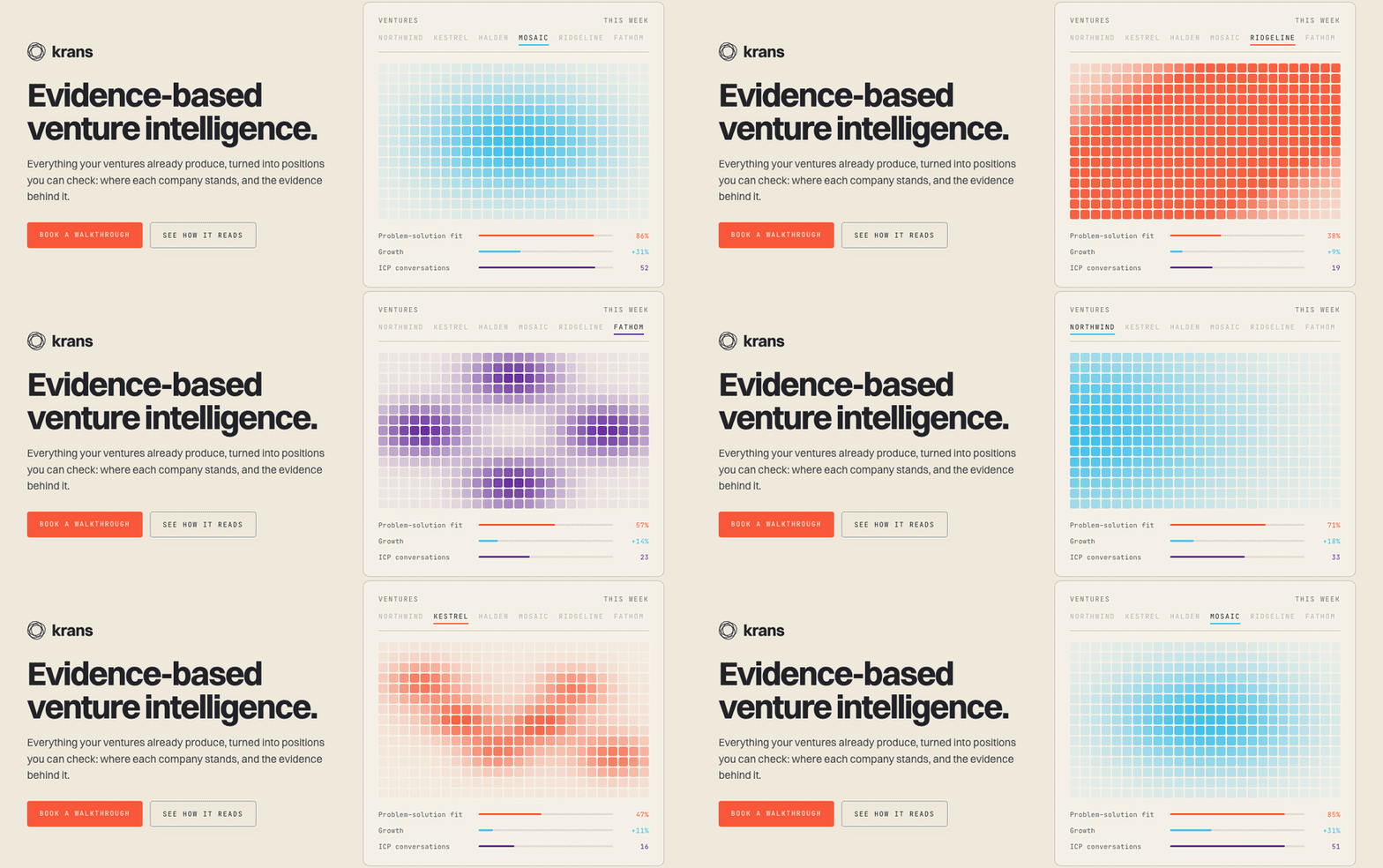
So we set out to build something that keeps that picture up to date on its own, and tells you what to do next.
What VSI was when we started, in December 2025
Krans started at Builders, where we co-found AI companies with founders from day zero, out of a studio in Rotterdam, and run several ventures in parallel.
The first version, written up in December 2025, was blunt about its job. It was an internal studio tool, and the blueprint called it a venture partner in a box: read all the data, track progress, turn it into next actions. Venture Studio Intelligence, or VSI.
One idea from that first document has survived everything since. Evidence gets graded from E0 to E5, and a belief only moves from candidate to validated when the evidence earns it. Enthusiasm doesn't move it. We got that right on the first try, and it's still the spine of the product.
What happened when we ran our own studio on it
The first companies Krans ever read were ours. Our ventures, our decisions, our numbers. If it couldn't tell us something about ourselves that we didn't already know, it had no business telling anyone else.
Everday, one of the companies we build with, had recorded every customer conversation since January 2024, so we gave Krans all of it at once: 28 months of calls with 292 companies. What surprised us wasn't the answer so much as how long it had been sitting there. The need that came back most, buyers who couldn't prove what their spending on skills and learning paid off, was already in the calls in 2024. It just never took up more than a sentence in any single conversation. Seeing it across all 292 companies changed what Everday sells, how it sells it and who it sells to. We've written that one up in full as its own use case.
How Krans works across everything a company produces
Krans plugs into the tools a company already uses. Call recordings, email and calendar, Notion, Drive and GitHub, the CRM and the pipeline, product analytics. Nobody types anything in. It turns all of that into a living picture of how the company actually works, then points at what's missing before the next step to market.
Under the hood, every source goes through the same steps. A call, an email or a document is broken into single learnings, each tied to the company and the person it came from. Learnings that keep coming back from different companies harden into signals, and signals add up to claims about the venture, each carrying its evidence grade. GitHub goes through the same steps, so the markdown docs and decisions teams keep next to their code land in the same picture.
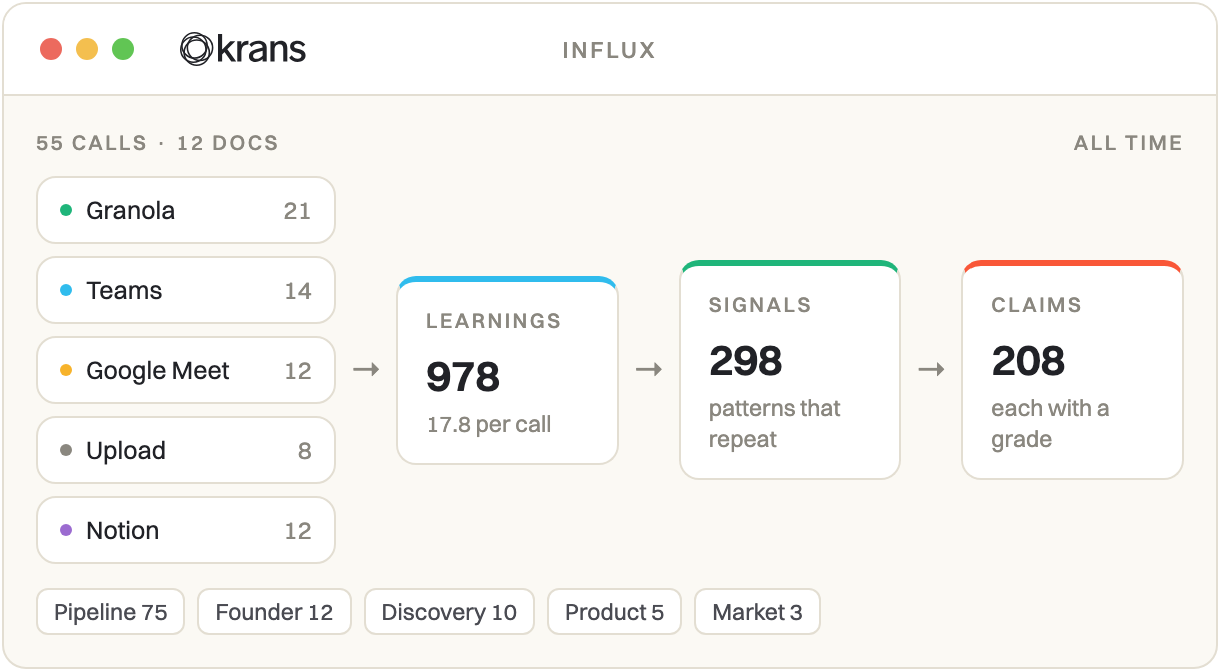
Three ideas sit underneath it, and none of them are clever.
Everything has to join up. A single call, email or deal update is close to useless on its own. The same buyer across five calls, a few emails and a deal that stalled in stage three is a story, and the story is where the information lives.
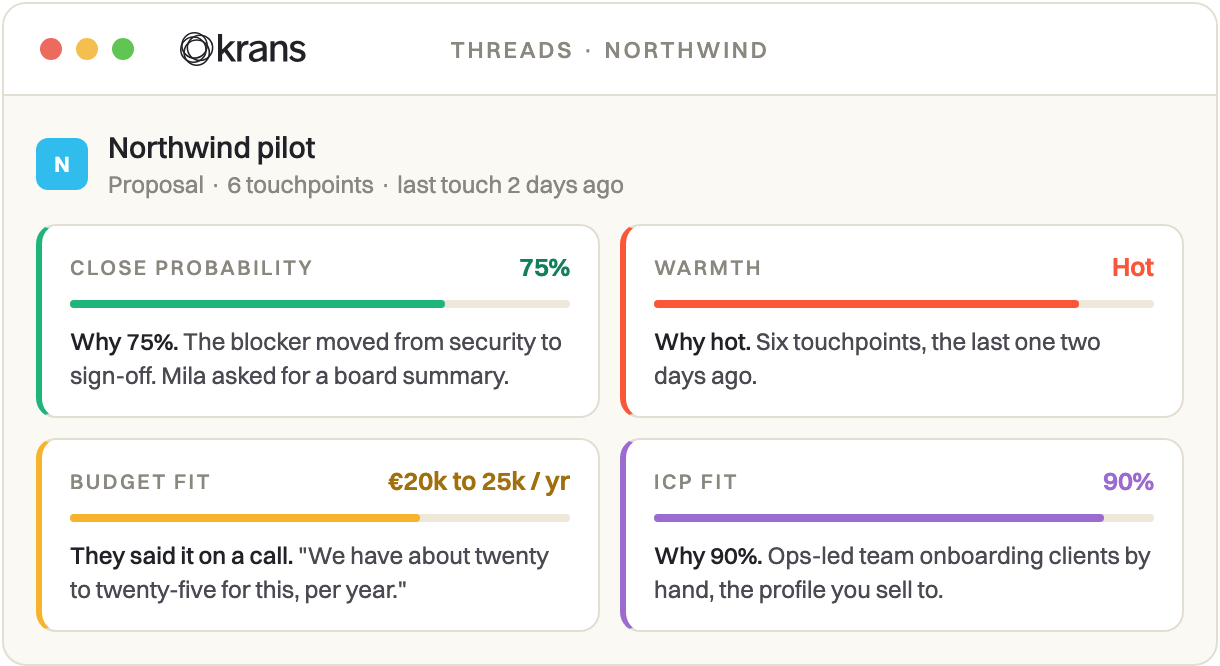
Repetition has to count. One person saying your onboarding is confusing is a person having a bad day. Five people saying it unprompted, across different companies, in the same month your activation numbers dip, is a fact about your product.
A claim carries how much you actually know. E0 is something inferred that nobody actually said. E5 is somebody putting something at stake. An offhand comment and a signed pilot are not the same kind of true, and evidence that stops being confirmed gets weaker on its own.
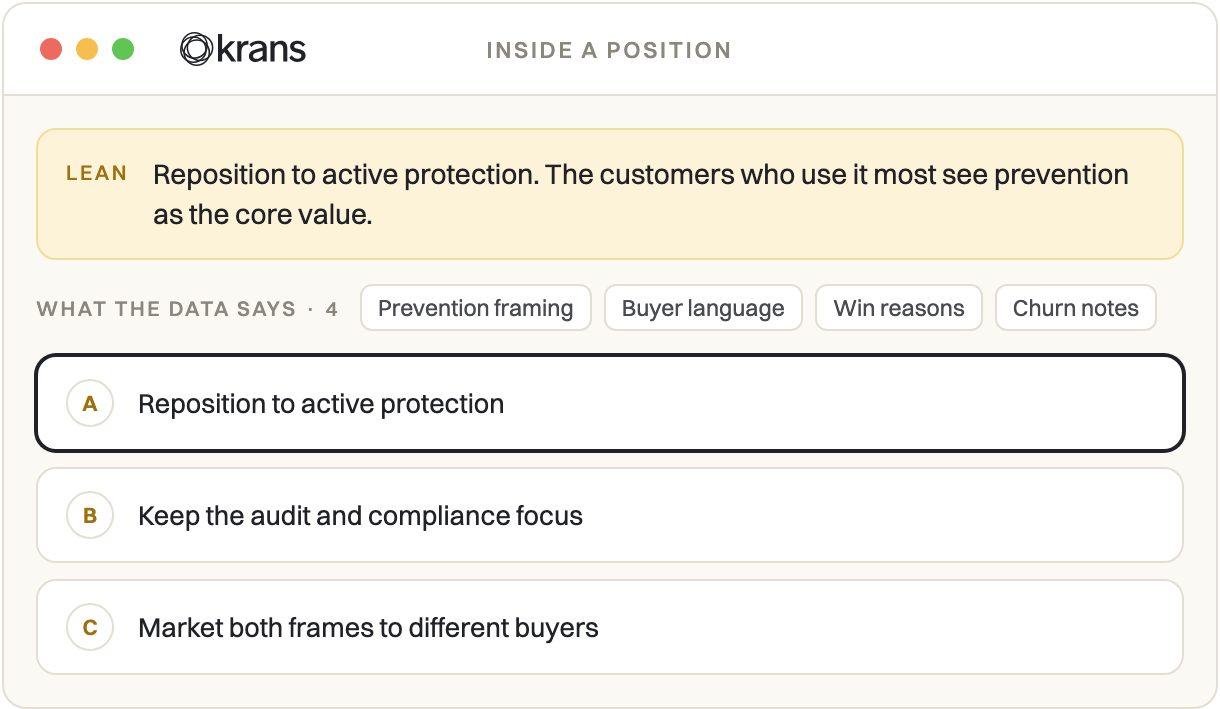
The part that matters most for going to market is what isn't there yet. Krans knows what stage a venture is at, and it tells you which piece of evidence you still need before the next step. Sometimes that's a buyer willing to name a budget, sometimes it's a retention number. Then it helps you go and get it. It looks forward, and it won't nag you about what you should have done last month.
Why we start with company builders
Underneath everything, Krans is about one thing: helping founders take their companies to market on evidence instead of guesswork. We just don't start with founders on their own.
We built the first version for founders doing their own discovery. It was the obvious call, and it turned out to be half right. A founder living inside one company mostly remembers what happened this week. The people who really can't keep up are the ones carrying ten companies at once, rebuilding the picture by hand every Monday. We know, because we were those people.
So we start with company builders: venture studios, corporate venture builders and funds. They feel the pain every day, and their portfolios are where the proof gets made. Company builders are where we start, and they're a long way from where this stops. There are a hundred times more single companies than company builders, and every one of them has the same go-to-market problem. The founders in our own batch already run on Krans, which is how it keeps getting sharper.
It isn't only for teams that call themselves AI-first, either. Most of the companies we talk to are still trying to get there, and honestly they need it more.
Why we renamed VSI to Krans
Krans is Dutch for a wreath. A circle woven from many stems, where no single stem holds it together and the shape only exists because they're woven. That's pretty close to what the product does. One call, one email or one deal update is a stem, and on its own it isn't much. Woven together with everything else a company produces, it becomes a picture of where you actually stand.
VSI stood for Venture Studio Intelligence. It was a good project name for an internal studio tool and the wrong one for what this became, so the rename and the repositioning happened as one decision. Giving it a real identity was a project of its own, and we're happy with where it landed: its own name, its own look and its own home.

The product, the team and the data stayed the same. The name changed, and so did how clearly we know who it's for.
Where Krans goes from here
Right now Krans tells you where each venture stands, what the evidence behind it is and what's still missing. Next it has to close the loop: remember what was decided and on what evidence, then come back later and tell you whether it held.
By 2027 we want to prove that following it works, with ventures built on Krans reaching real revenue inside a defined window. That's the go-to-market claim underneath everything we've written here, and until we can show it, we won't make it.
Further out, the picture is easy to describe and hard to build. Every company runs on Krans, and a studio can start ten ideas in parallel where each one opens already knowing what the whole network knows.
If you run a portfolio and you've ever rebuilt the whole picture by hand on a Sunday night, book a walkthrough. And if you've solved this some other way, we'd genuinely like to hear how.
This essay first appeared on the Builders blog.
Superpowers in this article
See what Krans reads in your own ventures.